

Originally published January 16, 2026. Updated August 20, 2026.
Written by Noah Schwab, CFP®, a financial advisor in Spokane specializing in Roth Conversion for retirees with over $1M+ in a 401k
If you’re a retiree with a traditional IRA, you may be looking for ways to minimize your taxes while supporting causes you care about. One powerful and often overlooked tool is the Qualified Charitable Distribution (QCD). As a Spokane financial advisor, I help retirees leverage QCDs to reduce taxable income, manage and avoid required minimum taxes on distributions (RMDs), and achieve charitable giving goals. In this guide, you’ll learn everything you need to know about QCDs, from eligibility, and tax benefits to strategic planning, timing and common mistakes.
What is a Qualified Charitable Distribution (QCD)?
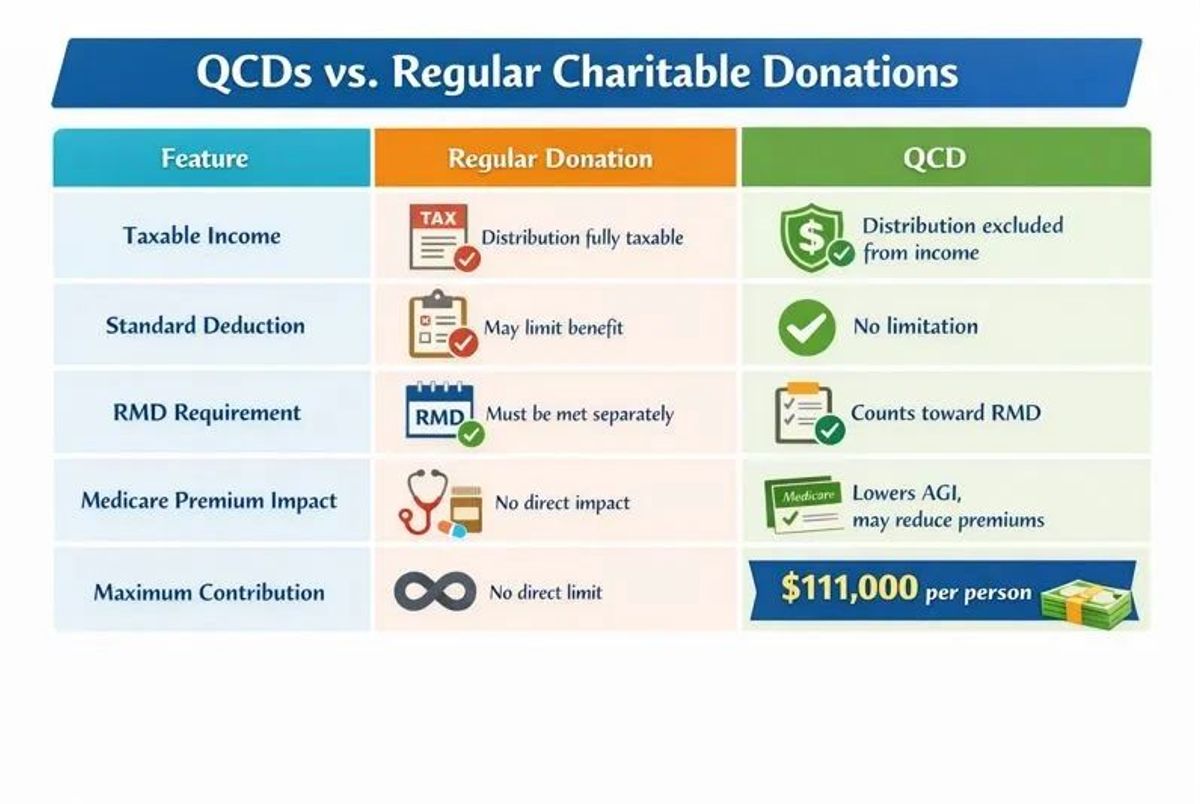
A QCD is a direct transfer of funds from your IRA to a qualified charity. The main benefit is that the distribution counts toward your Required Minimum Distribution (RMD) for the year, but it is excluded from taxable income. This makes QCDs a valuable tool for retirees who want to limit the tax impact of RMDs on income taxes while supporting charitable causes.
Who is Eligible for a QCD?
To make a QCD, you must meet the following requirements:
- Age Requirement: You must be 70½ or older at the time of the distribution.
- Eligible Accounts: Only distributions from traditional IRAs, including inactive SEP or SIMPLE IRAs, qualify. QCDs do not apply to 401(k)s or other employer-sponsored retirement plans, although funds can often be rolled into an IRA first.
- Eligible Charities: Funds must go to a qualified 501(c)(3) public charity. Donor-advised funds, private foundations, and supporting organizations do not qualify.
For more information, you can visit the IRS Publication 590-B

How Do QCDs Work?
Executing a QCD is straightforward but requires careful planning:
- Request a Distribution from Your IRA Custodian: Specify that you want to make a QCD and the amount to transfer directly to the charity.
- Direct Transfer is Critical: Funds must be sent directly from your IRA to the charity. Withdrawing the money yourself first disqualifies it as a QCD.
- Tax Reporting: You’ll receive Form 1099-R showing the distribution. The QCD is excluded from taxable income but should still be reported correctly on your tax return.
- RMD Counting: QCDs count toward your RMD, reducing your taxable income while fulfilling the IRS requirement.
This technique applies to traditional IRAs, not to Roth IRAs. For more information on the differences between a traditional IRA VS Roth IRA
The Benefits of QCDs for Spokane Retirees
QCDs offer multiple advantages that make them a valuable tool for retirement planning:
1. Reduce Taxable Income
RMDs from a traditional IRA are fully taxable as ordinary income. High-income retirees may face higher federal tax brackets, increased Medicare premiums (read article on IRMAA explained), and more taxation on Social Security benefits.
QCDs allow you to:
- Fulfill RMD requirements without increasing taxable income
- Lower adjusted gross income (AGI) to minimize Social Security and Medicare taxation. Check out this article on how to maximize Social Security.

2. Support Charitable Giving
QCDs let you give to charity in a tax-efficient way. Because the distribution is excluded from income, the charity receives the full donation. Benefits include:
- Supporting causes you care about consistently
- Reducing the tax burden on other retirement income
- Avoiding reliance on cash flow for charitable contributions
3. Reduce Medicare Premiums
Since QCDs lower AGI, they can reduce Medicare Part B and Part D premiums, also known as IRMAA. Even modest reductions in AGI can lead to meaningful savings over time. Check this out if you need to sign up for Medicare at 65, and learn how to avoid penalties.
4. Avoid Standard Deduction Limitations
For retirees taking the standard deduction, traditional charitable donations may provide little tax benefit. QCDs, however, reduce taxable income directly, regardless of whether you itemize deductions.
How Much Can You Give Through a QCD?
For 2026, you can give up to $111,000 per person. The limit is indexed annually. Married couples with separate IRAs can each give the full amount, effectively doubling it to $222,000. Coordinate your QCD with your RMD: if your RMD is $20,000 and you donate $15,000, the remaining $5,000 will still be taxable.
QCD Timing: The First Dollars Out Rule
Once you are old enough to be taking required minimum distributions, the first dollars that leave your IRA in a calendar year count as your RMD. Advisors call this the first dollars out rule, and it is the single most expensive thing most retirees do not know about QCDs.
Here is what it means in practice.
If you take your RMD in February and write your charitable checks through your IRA in November, you will pay tax on money you gave away.
You do not lose the QCD. A QCD in November is still excluded from your income. What you lose is the offset. The February distribution was already taxable, the RMD is already satisfied, and the November QCD lands on top of it as a separate withdrawal. Two withdrawals, one full tax bill, and nothing saved.
An example
Consider a hypothetical retiree, age 75, with a $60,000 required minimum distribution. She gives $20,000 a year to her church and two other organizations.
If she takes the full $60,000 as taxable income early in the year and then runs a $20,000 QCD in November, she reports $60,000 of income and $80,000 has left her IRA.
If instead she runs the $20,000 QCD in January and then takes the remaining $40,000 for herself, the RMD is satisfied, $60,000 has left her IRA, and she reports $40,000.
Same gift. Same charities. Twenty thousand dollars less in reported income. At a 22% marginal rate that is roughly $4,400 in federal tax, before you count what the lower AGI does to Medicare premiums and the taxable portion of Social Security.
This example is hypothetical and simplified. Your own numbers will look different.
If you take monthly distributions, read this twice
A lot of retirees set up systematic monthly withdrawals sized to cover the year's RMD. It is a sensible way to create a paycheck, and it quietly destroys this strategy.
If you are eight months into the year on a monthly draw, roughly two thirds of your RMD has already gone out as taxable income. There is only so much left to offset.
If you give to charity from your IRA and you are on a monthly schedule, that schedule needs to be redesigned, not abandoned. The usual fix is to run the QCD first thing in January and size the monthly distributions around what remains.
If it is already mid year
You have not lost everything. Whatever portion of your RMD has not yet been distributed can still be satisfied by a QCD. Pull your distribution history, find out exactly how much has gone out, and run the QCD against the remainder. Then fix the schedule for next year.
Using QCDs Before RMDs Begin
You become eligible for QCDs at 70½. Depending on your birth year, RMDs do not begin until 73 or 75. That gap is worth paying attention to.
QCDs made during those years do not offset anything, because there is nothing yet to offset. What they do is shrink the balance your future RMDs will be calculated on. Every dollar moved out now is a dollar that never gets multiplied by a distribution factor later.
For charitably inclined retirees in their early seventies, this is one of the quieter high-value moves available, and it is easy to miss because the benefit does not show up on this year's return.
Strategic QCD Planning
To maximize the benefits of QCDs, consider these strategies:
1. Meeting the Deadline
- A QCD has to be completed by December 31, and completed means the money has actually left your IRA and reached the charity. Not requested. Not in the mail.
- Custodians and charity offices both slow down in December. A QCD started the week between Christmas and New Year's can easily land in the following tax year, which is a frustrating way to lose a year of planning.
- If you are making several QCDs in one year, confirm each one with your custodian as it goes out. Processing errors are easier to catch in March than in February of the following year.
2. Combining with Other Tax Planning Tools
QCDs are most effective when paired with other strategies:
- Roth Conversions: a QCD keeps RMD income off your return, which leaves more room under a bracket or an IRMAA threshold for conversion income. Check out this article on Roth conversion tax strategies for Spokane retirees.
- Charitable Giving Ladder: spread donations across multiple years to smooth tax liability
- Medicare and Social Security Planning: reduce AGI to prevent higher Medicare premiums and taxable Social Security
3. Coordinating with Estate Planning
QCDs can also support estate planning goals:
- Reduce the taxable portion of your IRA for beneficiaries
- Preserve other assets for heirs while supporting charities
- Combine with donor-advised fund strategies, though QCDs cannot go directly into those funds

Common Mistakes to Avoid with QCDs
- Using an ineligible retirement account like a 401(k)
- Sending distributions to yourself first instead of directly to the charity
- Exceeding the annual limit per person
- Donating to non-qualified charities (donor-advised funds, private foundations). For more details, check out this article I wrote on donor-advised funds, explained by a Spokane financial advisor.
- Failing to report the QCD properly on your tax return
QCDs vs. Regular Charitable Donations
QCDs are often a more efficient strategy than taking a taxable IRA distribution and then making a regular charitable donation. In many cases, a QCD is one of the most powerful charitable giving tools available to retirees.
Key Takeaways
- QCDs are a tax-smart way to give and satisfy RMDs
- Only available at age 70½+, from IRAs, and must be direct transfers to eligible charities
- Maximum annual QCD: $111,000 per person for 2026 (will be indexed for inflation).
- Reduces taxable income, Medicare premiums, and Social Security taxation
- Work with a Spokane financial advisor to coordinate QCDs with Roth conversions, estate planning, and charitable goals

QCD Frequently Asked Questions (FAQ)
What is a Qualified Charitable Distribution (QCD)?
A QCD is a direct transfer from your IRA to a qualified charity, counting toward your RMD but excluded from taxable income.
Who is eligible to make a QCD?
You must be 70½+ and use a traditional, SEP, or SIMPLE IRA. 401(k)s are not eligible unless rolled into an IRA.
How much can I contribute?
Up to $111,000 per person per year in 2026 (will be indexed for inflation.) Married couples can combine for $222,000.
Which charities qualify?
Eligible 501(c)(3) public charities. Donor-advised funds and private foundations do not qualify.
Do QCDs count toward my RMD?
Yes, they fully satisfy RMD requirements while lowering taxable income.
How is a QCD reported on taxes?
Form 1099-R is issued, and the distribution is reported as non-taxable on your tax return.
Can I donate more than my RMD?
Yes, up to the annual limit. Amounts above your RMD do not carry forward to offset a future year's RMD, but they do reduce your account balance, which lowers what future distributions are calculated on.
Can I use a Roth IRA?
No. Roth IRA distributions are generally tax-free, so QCDs are unnecessary.
Can I donate to a donor-advised fund?
No. Only eligible charities qualify.
How can QCDs affect Medicare and Social Security taxes?
By lowering AGI, QCDs can reduce taxable Social Security and Medicare premiums.
Should I work with a financial advisor?
Yes. A Spokane financial advisor can coordinate QCDs with RMDs, Roth conversions, charitable goals, and estate planning.
Are you looking for a Spokane financial advisor who understands QCDs, RMDs, and tax-efficient retirement planning? Schedule a call with us to see how your IRA can work for both your retirement and your favorite causes.
Working With a Spokane Financial Advisor
As a Spokane financial advisor, I help retirees navigate RMDs, QCDs, and tax-efficient retirement planning. Planning your QCD strategy includes:
- Reviewing IRA accounts and RMD requirements
- Confirming eligible charities
- Timing distributions for tax efficiency
- Integrating QCDs with Roth conversions and estate plans
If you want to explore how QCDs can reduce taxes and support your favorite causes, contact a Spokane financial advisor today.
Bottom Line: QCDs are a highly effective strategy for managing RMDs, reducing taxable income, and supporting charitable giving. Understanding eligibility, contribution limits, and tax implications ensures you maximize benefits.
Talk with our Spokane Financial Advisor team

About the Author
Noah Schwab, CFP® is a financial advisor in Spokane, Washington, helping retirees with $ 1M+ maximize their 401(k) with Roth conversions and tax strategies.
- No commissions or insurance
- Investment management, tax, and financial planning
Noah Schwab, CFP®, is a Spokane financial advisor specializing in helping retirees with tax-efficient retirement income strategies, Roth conversions, and estate planning. This article is for educational purposes only and should not be considered tax or legal advice.