

Most financial advisors charge in one of four ways: a percentage of the investments they manage, a flat planning fee, an hourly rate, or commissions from financial products.
A common ongoing investment-management fee is around 1% per year, although the actual rate may be higher or lower depending on the size of your portfolio and the services included. A one-time financial plan often costs several thousand dollars, while hourly financial planning commonly costs a few hundred dollars per hour. Current consumer and industry research continues to show that percentage-based fees remain the most common pricing model. the percentage or dollar amount is only part of the question.
Before hiring a Spokane financial advisor, you should understand:
- How the advisor is paid
- What services are included
- Whether commissions or other incentives are involved
- What additional investment expenses you will pay
- Whether the advisor specializes in the decisions you need help making
If you are retired or getting close to retirement, those services may include much more than investment management. Roth conversions, Social Security, retirement income, Medicare premiums, charitable giving, taxes, and estate planning may all need to work together.
Here is what the most common financial advisor fee structures look like in 2026.
Financial Advisor Fees at a Glance
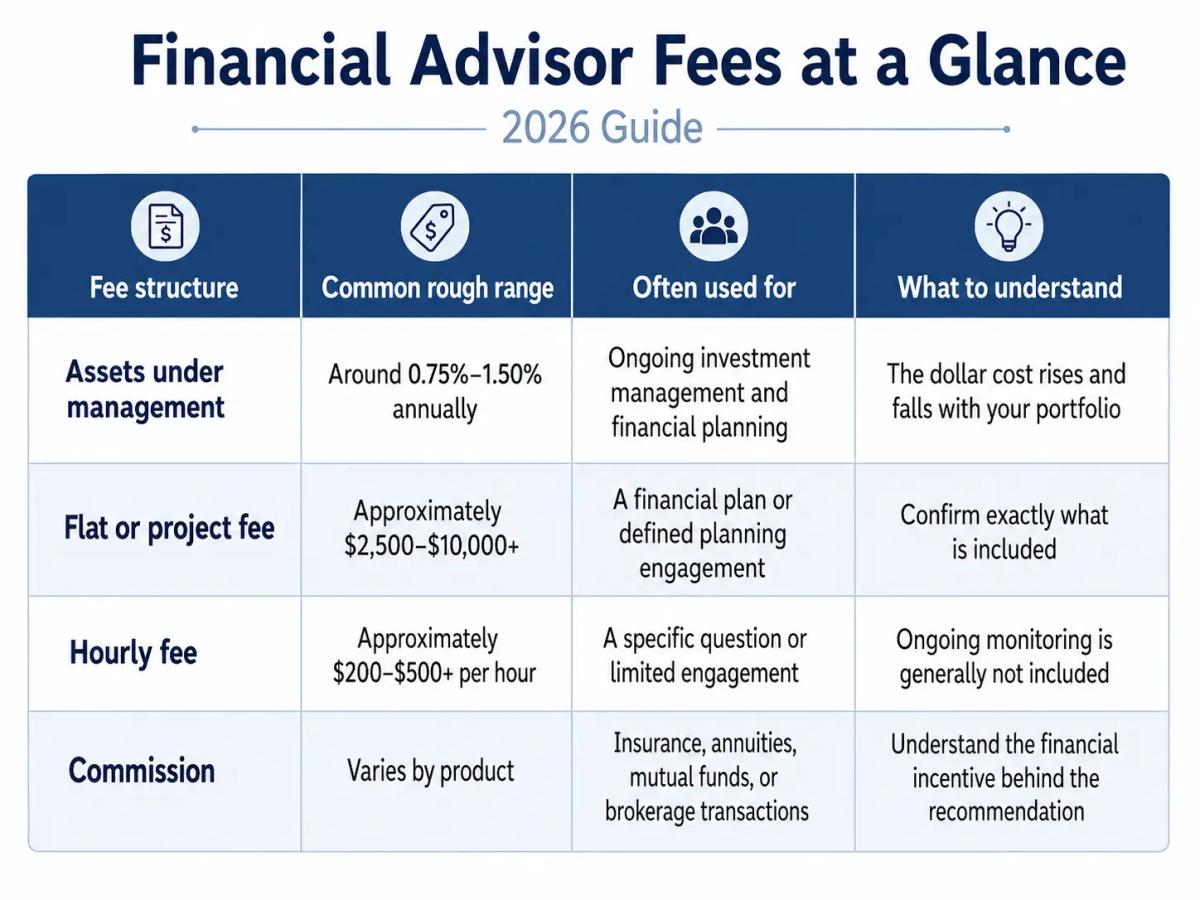
These are general ranges rather than universal standards. Fees can vary considerably based on the advisor, your portfolio, the complexity of your situation, and whether investment management is included.
1. Assets Under Management Fees
Assets under management, usually shortened to AUM, is one of the most common ways financial advisors charge.
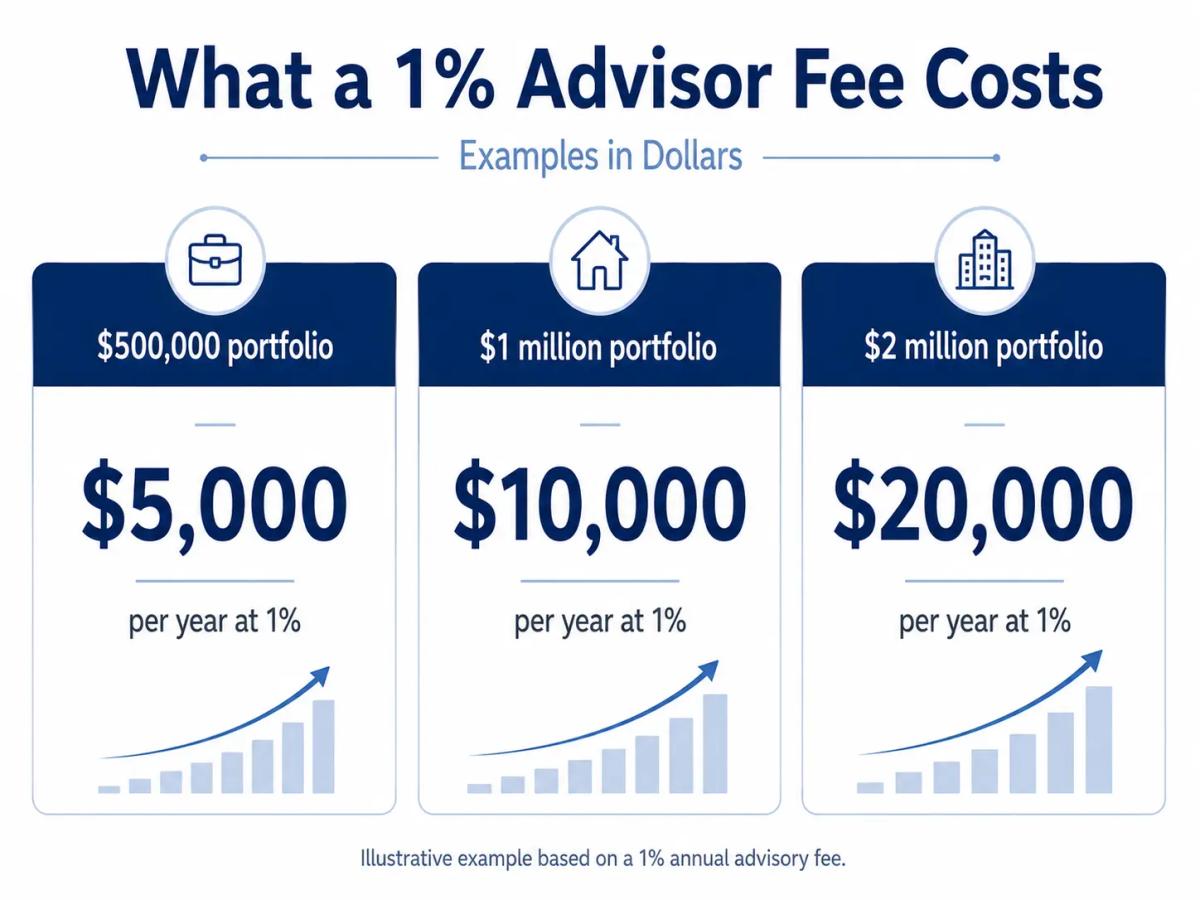
Under this model, you pay an annual percentage of the investments the advisor manages. The fee is often calculated and deducted from your investment account quarterly. As your account value changes, the dollar amount of the fee generally changes as well. example, a 1% annual fee would equal approximately:
- $5,000 per year on a $500,000 portfolio
- $10,000 per year on a $1 million portfolio
- $20,000 per year on a $2 million portfolio
Many advisors use tiered pricing, meaning the percentage charged on additional assets may decrease as the portfolio grows.
What does an AUM fee include?
The answer varies by firm.
Some advisors primarily provide investment management. Others include comprehensive financial planning, retirement-income planning, Roth conversion analysis, Social Security guidance, tax-aware withdrawal strategies, charitable planning, and coordination with your CPA or estate attorney.
That difference matters. Paying 1% for investment selection alone is very different from paying 1% for ongoing investment management and comprehensive retirement planning.
Ask the advisor to explain exactly what you receive and how often those services are provided.
Advantages of an AUM fee
An AUM arrangement can be convenient because the advisor handles the investment portfolio and deducts the fee directly from the account. You do not receive a separate invoice, and the relationship can include ongoing guidance as markets and your life change.
Potential drawbacks of an AUM fee
Because the fee is deducted from the account, it can be easy to overlook the actual dollar amount. Converting the percentage into dollars helps you evaluate the cost more clearly.
The fee may also grow substantially as your portfolio grows, even if the services you need do not change significantly. That does not automatically make the arrangement too expensive, but it makes understanding the scope of service especially important.
2. Flat Financial Planning Fees
A flat-fee advisor charges a stated dollar amount instead of, or sometimes in addition to, a percentage of your investments.
A flat fee may cover:
- A one-time comprehensive retirement plan
- A six-month planning engagement
- An annual financial-planning retainer
- Ongoing advice without investment management
- A specific project, such as pension analysis or Roth conversion planning
A comprehensive financial plan often costs a few thousand dollars, while ongoing retainers can cost more depending on the work involved.
When a flat fee may make sense
A flat planning engagement can work well when you want a professional second opinion but are comfortable implementing the recommendations yourself.
For example, a Spokane couple approaching retirement may want help answering questions such as:
- Can we afford to retire next year?
- Should we roll over a 401(k) or leave it where it is?
- Should we take a pension or a lump sum?
- When should each spouse claim Social Security?
- Should we convert part of an IRA to a Roth?
- How much can we safely spend?
- How will a surviving spouse’s taxes change?
A flat-fee plan can organize these decisions without requiring you to hire the advisor indefinitely.
The tradeoff is that you may be responsible for implementing and monitoring the recommendations after the engagement ends.
3. Hourly Financial Advisor Fees
Hourly advisors charge based on the time spent reviewing your situation, meeting with you, researching your questions, and preparing recommendations.
This model can be helpful when you have one or two clearly defined decisions.
For example, you might hire an hourly financial planner to evaluate:
- A pension versus lump-sum decision
- A proposed 401(k) rollover
- A Roth conversion
- An early-retirement package
- Social Security claiming options
- Whether an annuity recommendation makes sense
- A withdrawal or investment strategy
Hourly advice gives you control over the scope and cost of the engagement. However, it generally does not include ongoing monitoring unless you schedule and pay for additional meetings.
Some people also hesitate to contact an hourly advisor when new questions arise because they know the clock is running. Consider whether you want occasional advice or an ongoing relationship before choosing this model.
4. Commissions
Commission-based financial professionals are compensated when a client buys or sells certain investments, insurance policies, annuities, or other financial products.
You may not receive a separate advisory bill, but that does not mean the advice or product is free. The compensation may be built into the product’s expenses, surrender charges, sales loads, or other costs.
Commissions do not automatically make every recommendation inappropriate. However, they create an incentive that you should understand before moving forward. Ask:
- How much will you or your company receive?
- Is the commission paid upfront or over time?
- Are less expensive alternatives available?
- Will I pay a surrender charge if I change my mind?
- Are you acting as a fiduciary when making this recommendation?
This is especially important with annuities and permanent life insurance, where the products can be complicated and the long-term costs may be difficult to evaluate.
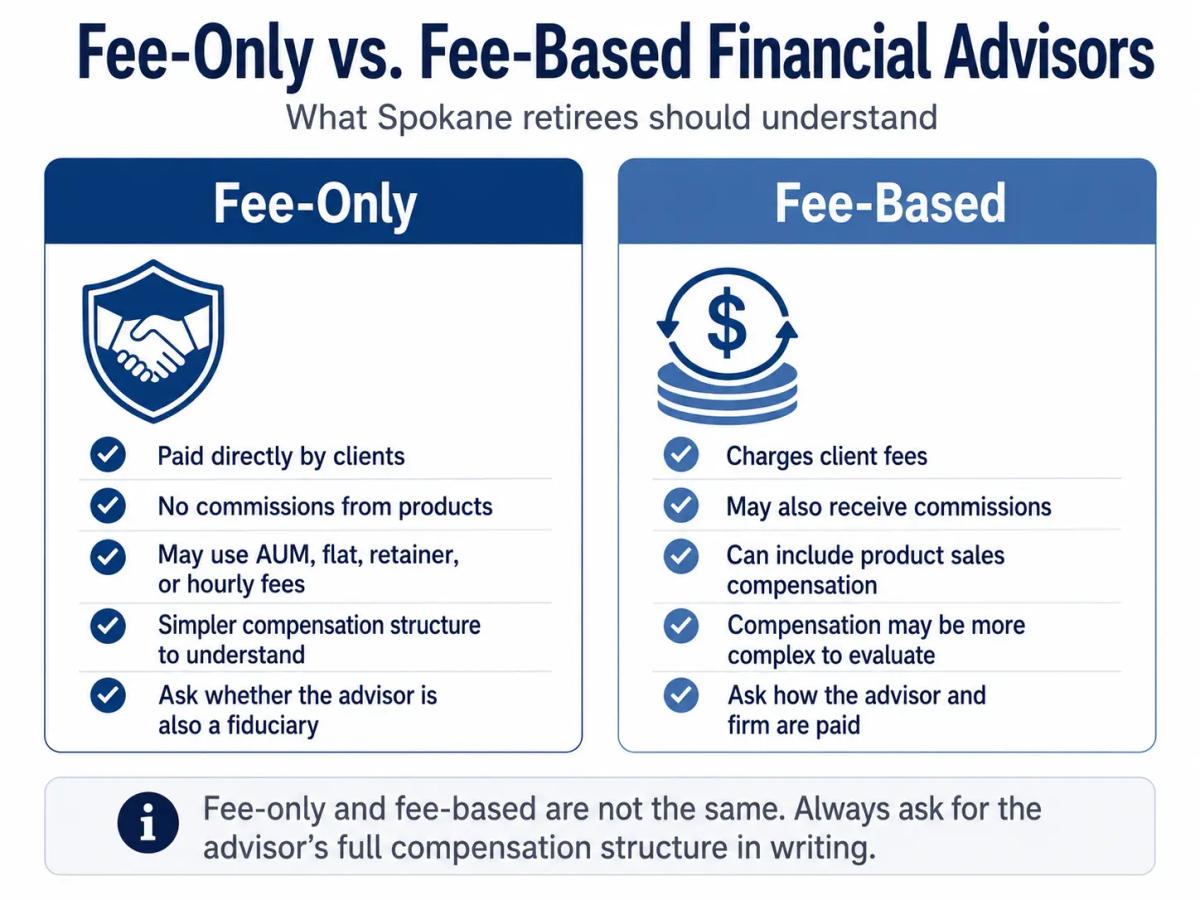
Fee-Only Versus Fee-Based Financial Advisors
These terms sound nearly identical, but they describe different compensation arrangements. For CFP® professionals, CFP Board’s fiduciary standards require them to act in the client’s best interests whenever they provide financial advice.
Fee-only financial advisor
A fee-only advisor is compensated directly by clients through AUM fees, flat fees, hourly fees, retainers, or a combination of those arrangements.
Fee-only advisors do not receive commissions for recommending insurance or investment products. This eliminates product-sales compensation, although every business model can still have potential conflicts that should be clearly disclosed.
Stewardship Concepts is a fee-only fiduciary financial advisory firm in Spokane. We do not sell insurance products or receive commissions from investment recommendations.
Fee-based financial advisor
A fee-based advisor may charge clients an advisory fee while also receiving commissions or other compensation from certain products.
Because “fee-only” and “fee-based” sound so similar, do not rely on the label alone. Ask the advisor to explain every way the advisor and the advisor’s company can be paid.
What Additional Costs Should You Ask About?
The advisor’s stated fee may not be the only expense coming out of your portfolio. The SEC’s Investor.gov also recommends understanding the other fees and costs associated with an advisory account and its investments.
Investment expense ratios
Mutual funds and exchange-traded funds generally have internal operating expenses. These are separate from the advisor’s fee.
For example, if you pay a 1% advisory fee and your investments have an average expense ratio of 0.25%, your combined cost is approximately 1.25% before considering any transaction or custodial expenses.
Trading and transaction costs
Depending on the custodian and investments used, you may pay transaction fees, ticket charges, markups, markdowns, or trading spreads.
Custodial and account fees
Some custodians charge account-maintenance, wire, transfer, or termination fees. Ask for a list of expenses that may apply.
Insurance or annuity expenses
Annuities and insurance policies may include mortality expenses, administrative expenses, investment expenses, rider fees, surrender charges, and commissions.
Financial planning fees
Some firms charge an AUM fee and a separate financial-planning fee. Others include planning in the asset-management fee.
Neither structure is automatically better. The important thing is receiving a clear, all-in explanation in dollars.
Registered investment advisers must disclose their compensation and other expenses in their Form ADV brochure. That disclosure should explain the firm’s fee schedule, billing practices, and additional costs clients may incur.
Is a 1% Financial Advisor Fee Worth It?
A 1% fee may be reasonable when the advisor delivers ongoing, comprehensive work that is relevant to your situation. It may be difficult to justify when the service consists mainly of choosing investments and holding an annual review meeting.
For retirees, the most valuable work often involves coordinating decisions rather than trying to predict which investment will perform best.
That can include:
- Building a sustainable retirement-income plan
- Deciding which accounts to withdraw from first
- Evaluating multi-year Roth conversions
- Coordinating withdrawals with Social Security
- Managing required minimum distributions
- Watching Medicare IRMAA thresholds
- Using qualified charitable distributions
- Planning for a surviving spouse
- Coordinating with a CPA and estate attorney
- Keeping the investment strategy aligned with future spending
Consider a Spokane retiree who has a pension, Social Security, a traditional IRA, a taxable investment account, and regular charitable giving. A decision to convert part of the IRA to a Roth may affect federal taxes, Medicare premiums, cash flow, future required distributions, and the amount eventually inherited by children.
The advisor’s job is not simply to say, “Do a Roth conversion.” The job is to determine whether it makes sense, how much to consider, when to do it, and how it fits with everything else.
No advisor can guarantee that planning will produce savings greater than the fee. The better question is whether the advice helps you make better-informed decisions, avoid preventable mistakes, and feel confident about how your financial life fits together.
What Does a Spokane Financial Advisor Charge?
Spokane financial advisor fees vary based on the firm, its specialty, and the services it provides.
Some local advisors charge AUM fees. Others offer hourly advice, planning projects, annual retainers, or a combination of these structures.
At Stewardship Concepts Financial Services, our current pricing includes:
- Ongoing financial planning and investment management: An AUM fee beginning at 1%, subject to a $3,000 annual minimum
- Standalone retirement-planning engagement: A flat fee of $3,000
If most of your retirement savings are in an employer plan, our guide to retiring with a large 401(k) explains the income, tax, rollover, and Roth-conversion decisions that often come next.
Our ongoing service is generally designed for households with more than $1 million or more in 401(k), IRA, or 403(b) accounts, but that is the type of situation we most often serve rather than a universal requirement. work focuses on retirement income, Roth conversions, Social Security, tax-aware planning, investment management, charitable giving, and coordinating the pieces of a retirement plan.
How to Find Out What an Advisor Really Charges
You do not need to rely only on an advisor’s website or verbal explanation.
Every registered investment adviser files a public disclosure document called Form ADV. It includes information about the firm’s services, fee schedule, compensation, conflicts of interest, and disciplinary history.
You can search for a firm through the SEC’s Investment Adviser Public Disclosure database and review its current filings. every advisor these questions:
- How are you and your company paid?
- Are you fee-only, fee-based, or commission-based?
- Are you a fiduciary at all times when advising me?
- What will I pay during the first year in actual dollars?
- What expenses will I pay in addition to your fee?
- What financial-planning services are included?
- How often will we meet?
- Who will I work with after I become a client?
- Will you put your complete fee schedule in writing?
- Where can I find your Form ADV and relationship summary?
A trustworthy advisor should be able to answer these questions clearly. Fees are important, but they are only one part of the decision. Our guide to choosing a Spokane financial advisor covers the other questions and warning signs worth considering.
Frequently Asked Questions About Spokane Financial Advisor Fees
How much does a financial advisor in Spokane cost?
Many Spokane financial advisors charge around 1% of the investments they manage, although pricing varies by portfolio size and services. Flat financial-planning engagements may cost several thousand dollars, and hourly advisors commonly charge a few hundred dollars per hour. Always ask what is included and request the total cost in dollars.
How much does a financial advisor charge on $1 million?
At a 1% annual AUM fee, an advisor would charge approximately $10,000 per year on a $1 million portfolio. A tiered fee schedule may produce a different amount. Investment expenses, transaction costs, or separate planning fees may also apply, so ask for the all-in annual cost.
Is paying a financial advisor 1% too much?
Not necessarily. A 1% fee may be reasonable when it includes ongoing investment management and comprehensive retirement planning. It may be expensive if the advisor provides little beyond investment selection. Evaluate the advisor based on the services, expertise, communication, and planning work you actually receive.
Is a fee-only financial advisor always cheaper?
No. Fee-only describes how the advisor is compensated, not whether the advisor is inexpensive. A fee-only advisor may charge an AUM fee, flat fee, hourly fee, or retainer. The primary benefit is that the advisor does not receive commissions for selling financial products.
What is the difference between fee-only and fiduciary?
Fee-only describes compensation. Fiduciary describes the standard of care the advisor is required to follow. They are not interchangeable terms. Ask whether the advisor is fee-only and whether the advisor agrees to act as a fiduciary whenever providing advice to you.
Do financial advisors charge for the first meeting?
Many financial advisors offer an introductory meeting at no cost so both sides can determine whether the relationship appears to be a good fit. This meeting normally provides general information rather than personalized financial advice. Confirm the policy before scheduling.
Can I hire a financial advisor for only one project?
Yes. Some advisors offer one-time retirement plans, hourly consultations, pension analysis, Roth conversion planning, or other limited engagements. This may work well when you want an independent review but plan to manage and implement the recommendations yourself.
What should a retirement financial advisor help with?
A retirement-focused advisor should be able to help coordinate retirement income, investments, 401(k) rollover decisions, Roth conversions, Social Security, required minimum distributions, Medicare premiums, charitable giving, taxes, and estate-planning considerations. The advisor does not need to replace your CPA or attorney, but the recommendations should work together.
Choosing the Right Fee Structure
There is no single pricing model that is best for everyone.
An hourly or project-based planner may be appropriate when you need help with one decision. A flat retainer may work when you want ongoing planning but do not want the cost tied to your portfolio. An AUM relationship may make sense when you want an advisor to manage your investments and provide continuing financial planning.
The goal is not simply to find the lowest fee. It is to understand what you are paying, what you receive, and whether the advisor’s experience matches the decisions in front of you.
Talk With a Fee-Only Spokane Financial Advisor
If you are retired or nearing retirement and want a clearer understanding of what financial advice would cost, we would be glad to explain our services and pricing.
Stewardship Concepts Financial Services is a Spokane-based, fee-only fiduciary firm that works primarily with retirees and near-retirees. We help clients make coordinated decisions about retirement income, investments, large 401(k) and IRA balances, Roth conversions, Social Security, charitable giving, and taxes.
The initial discovery call is offered at no cost and without a commitment to move forward.
Schedule a Discovery Call.

About the Author
Noah Schwab, CFP® is a financial advisor in Spokane, Washington, helping retirees with $ 1M+ maximize their 401(k) with Roth conversions and tax strategies.
- No commissions or insurance
- Investment management, tax, and financial planning
Noah Schwab, CFP®, is a Spokane financial advisor specializing in helping retirees with tax-efficient retirement income strategies, Roth conversions, and estate planning. This article is for educational purposes only and should not be considered tax or legal advice.