

It can be confusing to know the difference between a financial advisor and an accountant at times. Even though both accountants and financial advisors work with financial data and offer financial services, their exact areas of expertise and responsibilities vary. Knowing the similarities, and differences can help you decide when you need to seek their help. Whether to use a financial advisor or accountant for help will depend on your specific need. To find your Spokane financial advisor or accountant, reach out to us.
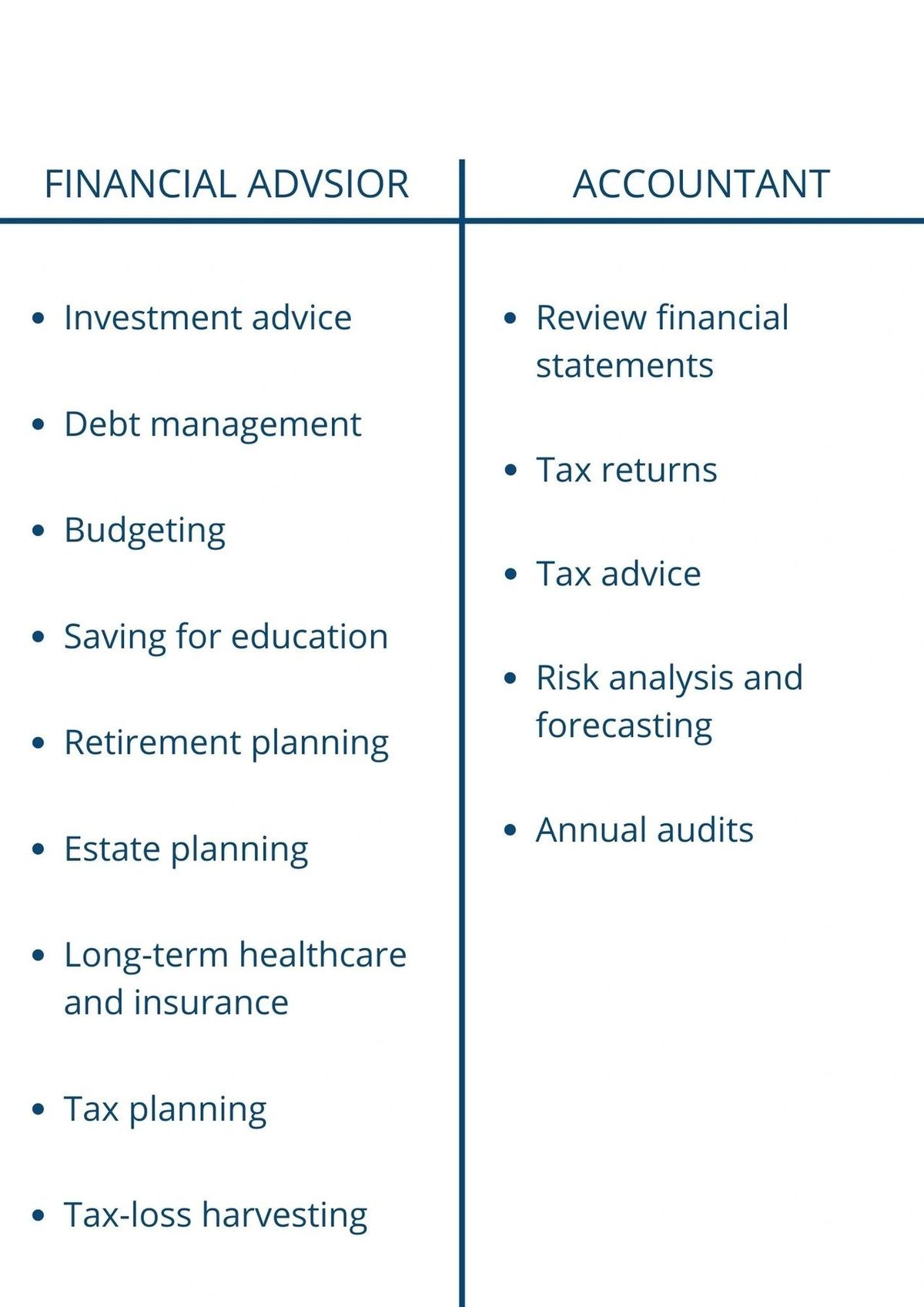
Roles of a financial advisor:
Investment advice: If your investments fit your level of risk, goals, and style.
Debt management: Analyze and create strategies to pay down and avoid debt.
Budgeting: Help you build and meet your short and long-term budget.
Saving for education: Create a strategy to save money for children's education
Retirement planning: Create a savings plan and retirement target. Revisiting the plan to see if you are on track for hitting your retirement goals.
Estate planning: Develop and recommend estate planning strategies like titling accounts, and making sure wills and POAs are in place.
Long-term healthcare and insurance: Provide long-term solutions to reduce risk without paying too much.
Tax planning: Contribute to accounts efficiently and manage tax liability, by doing Roth conversions and Qualified Charitable Distributions
Tax-loss harvesting: Realising capital loss positions at the end of the year to offset taxable income.
Roles of an accountant:
Review financial statements: See if documents are accurate and correct.
Tax returns: Prepare personal and business tax returns
Tax advice: Advising on areas for opportunity to save on cost saving or efficiencies.
Risk analysis and forecasting: Providing future predictions and analysis on business financials.
Annual audits: See if personal and business records are correct and accurate.
Differences between financial advisors and accountants
Accountants tend to focus on the past, while financial advisors focus on the future. Accountants analyze and report on financial transactions that have already occurred in that year, while financial advisors help clients set financial goals, strategies, and investments for the future.
Accountants can be a more specialized area of tax, while financial advisors will typically have a broader knowledge base.
Accountants lean toward compliance and reporting, while financial advisors are focused on financial planning and wealth management. Accountants have one option for education, achieving a CPA (Certified Public Accountant). While financial advisors may have a variety of educational backgrounds and may hold many different professional designations. But the most popular and widely known designation is a CFP ® (Certified Financial Planner ™).

Similarities between accountants and financial advisors:
Accountants and financial advisors both work in finance and help individuals and organizations manage their finances.
Financial advisors and accountants require a high level of knowledge and expertise in financial matters.
Both jobs require problem-solving and analytical skills.
Those that hold CPA and CFP ®certifications are required to uphold professional standards like confidentiality and be a fiduciary, requiring them to act in their client’s best interest.
How can you decide whether you need an accountant or a financial advisor?
Most people use both but use the following questions to determine whether you need a financial advisor or an accountant:
What financial tasks do you need help with? An accountant may be a better option if you require assistance with tasks like completing and submitting your tax returns or evaluating financial records. A financial advisor may be more appropriate if you require assistance with developing a long-term financial strategy, investing your money, or managing risk. How much time and energy are you willing to devote to managing your money? Financial advisors offer advice and support to help you make well-informed decisions, while accountants can save you time and effort by doing financial responsibility for you.
If you possess the knowledge, confidence, and desire required to DIY your finances, you may not require the assistance of an accountant or financial advisor if you are confident in your capacity to manage your finances. Even if you feel confident, typically you will run into a situation where you won’t so it helps to know a CPA or financial advisor that you trust. Both accountants and CPAs typically offer a free consultation to talk through and find out if they can help. If you want to talk to one of our financial advisors, contact us.
About the Author
Noah Schwab CFP® is a financial advisor in Spokane, Washington who specializes in helping Spokane small business owners.
- Synergizing business and personal finances
- Setting up retirement plans
- Investment management
Links:
Accountants: Link
Financial advisor: Link