
In today's economic landscape, many challenges confront our nation. One is the weight of our national debt. This is an important topic that politicians continue to avoid. We need to seriously address our nation's fiscal spending, easy monetary policies, and the sustainability of social programs like Social Security. Our debt is not an 800 but an 8,000-pound gorilla in the room. The further we delay solving our country's systemic relationship with debt, the better it will be for future generations.
Where We Are Today
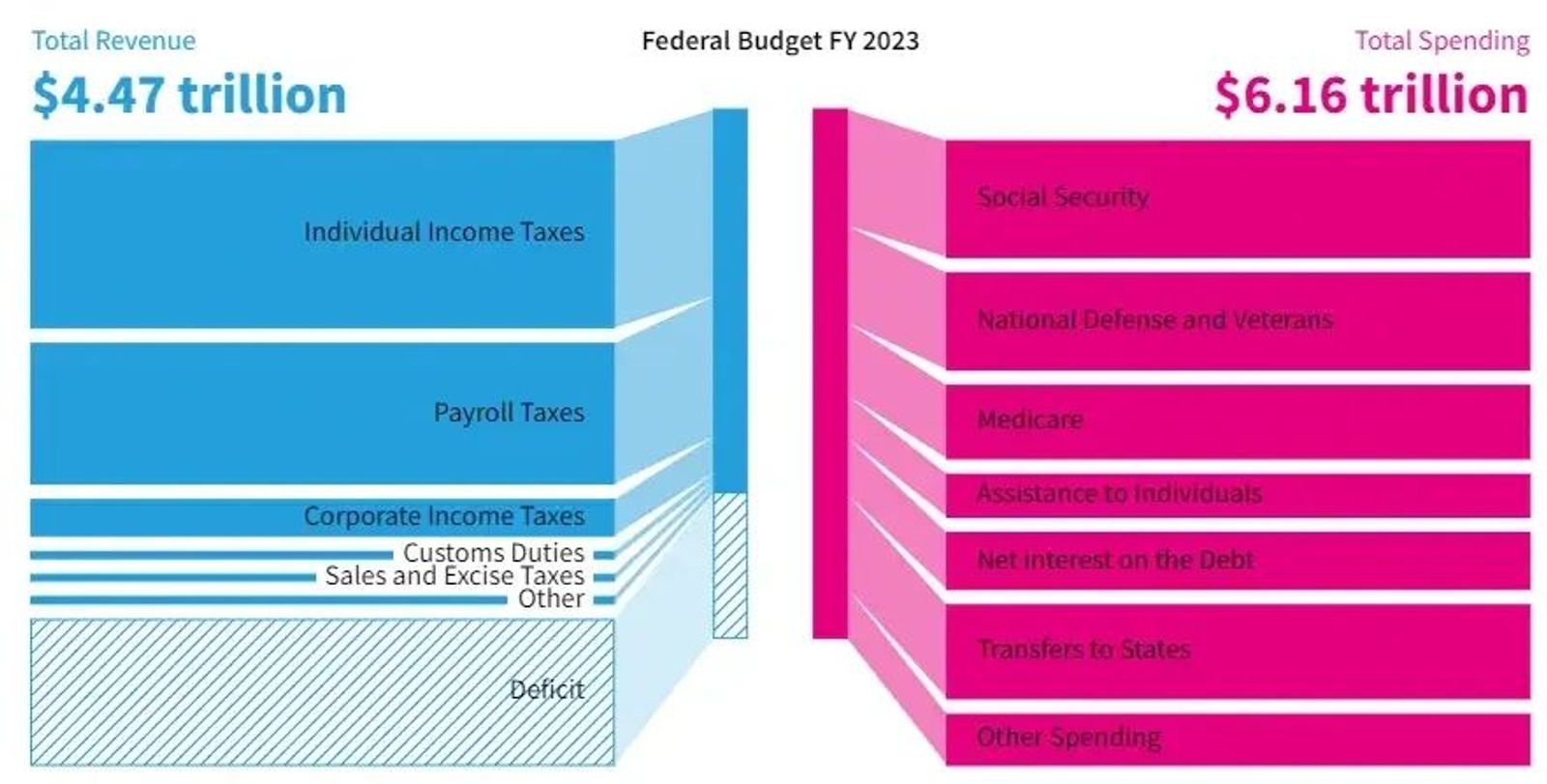
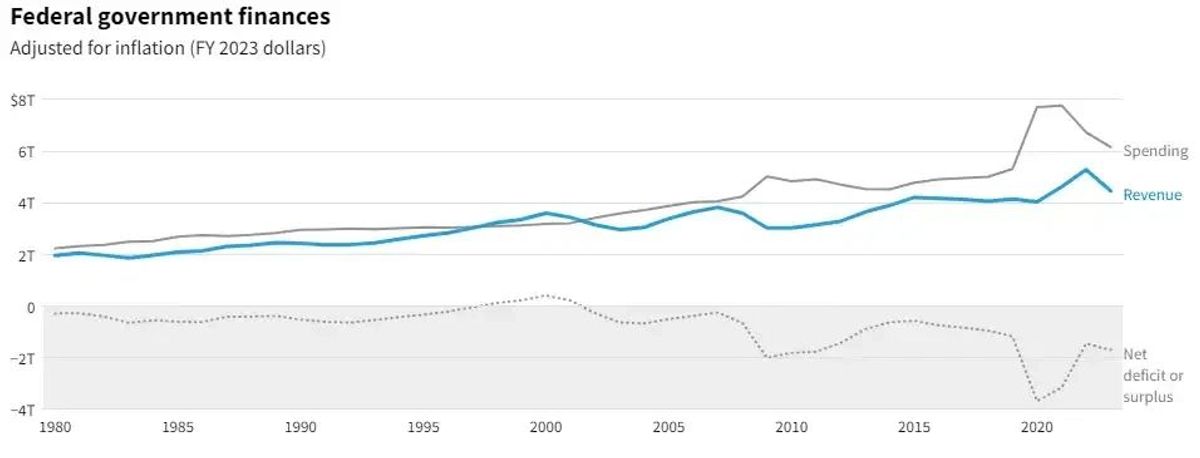
For 2023, the federal government collected $4.5 trillion in revenue and spent $6.2 trillion. This means that the federal government spent 1.7 trillion more than it collected. Our government had to borrow $1.7 trillion to maintain its current budget. It doesn't take someone with many brains to realize it's unsustainable.
The top three expenses for our government are Medicare and Medicaid and other health insurance subsidies at 24%, Social Security at 21%, and defense at 13%.
Social Security has the most problems. It's been borrowed from and is underfunded. A significant headwind to Social Security is our country's low birth rate. Many developed countries worldwide, including ours, are experiencing low birth rates. This puts pressure on social programs because fewer people will be working to fund programs when older generations enter retirement and draw from Social Security, Medicaid, and Medicare.
As of 2024, our national debt is $34 trillion. The estimated interest we are paying on our debt this year is $870 billion—that is correct: billion with a "B." Our debt is estimated to increase to $951 billion in 2025.
If you wonder who holds most of our debt, it's us. The U.S. public has the most of our debt at almost 20 trillion. Then it's at similar lower levels with other countries and our federal government at 7 trillion each. The biggest foreign country holding our debt is Japan, at 1.1 trillion of all debt owned by foreign countries. One of the most common myths I heard is that China owns all our debt. They own 860 billion foreign country debt, less than 2% of our total national debt.
Another piece of this problem is interest rates. Because inflation has risen, our government has raised interest rates to constrict the money supply and control inflation. The FED hesitates to lower these levels to avoid a situation like the 80s, where rates were cut too quickly, and inflation rose again.
This time around, interest rates will stay higher for longer. Carrying debt didn't cost us much for the past decade; now, it will hurt more. When our government has to repay the bonds to their issuers, it will have to issue a new bond at a higher interest rate, costing even more interest payments. 31% of all U.S. government debt will mature over the next year.
How did we get here?
There are many reasons why we got here. Many people in Washington don't want to touch the problem because fixing it will be painful. A politician doesn't want to be known for causing pain. But if we make this issue important enough, we can show them that they must address this if they want to be elected. We are to blame just as much as our politicians. We are complacent and want to avoid the solution to our problem.
If someone called into Dave Ramsey's radio show with their finances in the same shape as our government, he would have a lot of things to say, and none of them would be a good job.
Dave teaches about snowballing out of debt, paying off the smallest loan, and using that momentum to pay off the next biggest loan. But our country is doing the exact opposite. We are snowballing into more debt. With interest rates rising, we must take out a higher loan to pay off the interest rates of the other loans. This must stop.
A second grader knows that that isn't smart. Why have we put ourselves in this situation? We've passed additional spending bills no matter which party is in control. During COVID, Trump added $8.4 trillion to our debt. Biden passed the Inflation Reduction Act, which cost $369 billion, and the CHIPS and Science Act, which cost $280 billion, and he's forgiven student debt so far, spending 138 billion. We are funding two wars in Ukraine, and in Israel, we've given aid to Israel and Gaza. This is not about one political side. There is blame on all political sides right now.
Social programs are a massive barrier to debt sustainability. These programs have become the primary sources of income for many Americans. It is almost impossible to eliminate these programs while so many people live month to month with this income. We need to find a responsible way to fund these programs, like increasing the retirement age and the amount of tax. Another solution could be to increase the number of workers by promoting a higher birth rate or increasing legal immigration.
Effects on Our Economy
If we continue down this path of debt snowball, something will break. Who knows what will break the camel's back, but it will hurt. If we don't address it, it will most likely be a crisis scenario that stresses our financial system when it breaks.
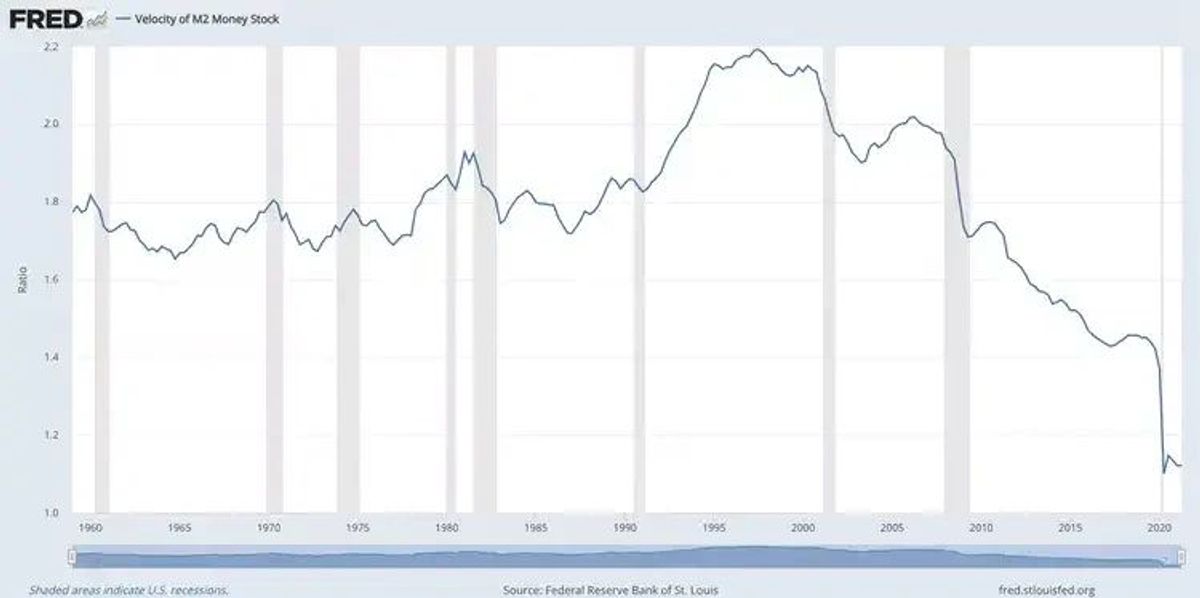
This debt we are taking on is not helpful. In the past, our government has justified spending a dollar because it is circulated and taxed through sales tax and provided other jobs; it's been productive debt. They can measure this through the velocity of money, which measures how often money is exchanged between people. But in recent years, the velocity of money has dropped dramatically, reducing its economic benefit, as seen on the graph.
If we continue down this path, our debt will drag on our economy's growth because of growing costs. Highly indebted countries experience low capital investments, infrastructure, and education. Taxes will have to be increased, and expenses will be cut. Where or how that must happen is unknown, but the longer we wait, the worse it gets. And the longer we wait to fix the problem, the more vulnerable our economy is to the next disaster. What will happen to our budget when we enter the next war or experience another pandemic-like event? We saw how vulnerable we were in 2020 when our debt skyrocketed.
Imagine running a balanced budget and growing a cash reserve for future disasters. We would leave a great legacy for the next generation, and they wouldn't have to worry about their country's impending doom.
Significant historical examples exist where great powers have suffered from high levels of indebtedness: Rome, Imperial Spain, Qing Dynasty, and the United Kingdom. We need fiscal responsibility. But we aren't too far gone. There are modern examples that give us hope. In the 18th and 19th centuries, after a failed war in America and against France, Britain was able to restrain spending and reduce indebtedness. Sweden, Denmark, Finland, and Canada are all modern-day examples where they have consistently reduced their indebtedness.
Historically, America has shown restraint in the past, reducing the debt-to-GDP ratio after the Revolutionary War and Civil War, and it has been kept lower than other developed nations for the majority of the time. There also have been reforms reducing spending. Our current environment is an exception to the history of our government. It is now up to us to help our elected leaders move the needle back to fiscal responsibility so the United States is a safe place to call home for the next generation.
How Do We Invest Knowing This?
Now that we know this, how do we invest with this 8000-pound gorilla in the room? We don't try to time a market crash. The risk of what's going on in our country is a risk you're taking whether you have money in the stock market or cash in the bank. Our stock market, banking system, and fiscal spending are tied together. They all affect one another. If the United States defaults on its debt, it will ripple throughout the U.S. and the world. You're taking this risk with the potential of losing your job, business, home value, stocks, bonds, and cash.
Avoiding the stock market is a risk as well. If someone's money is in savings, maintaining value, it's losing purchasing power because of inflation. That's a risk. This isn't to say you shouldn't invest in all these areas, but it's to help you realize that you can't help but absorb some risks. Don't try to control what you can't.
Do what you can to reduce risk. Add diversification and invest in quality. Investing in quality companies is one of the ways to fight against inflation. A stock is a calculation of how profitable a business is. If Coke raises the prices of its drinks, the company will be worth more, and the value of the stock will rise. The United States continues to be a hub of innovation and growth.
Reduce risk by staying diversified through quality companies, investment-grade bonds, commodities, and real estate in the United States and internationally. We can't time the markets, and we don't try to. Create an allocation that achieves your goals with the least amount of risk. As investment managers, we continue to invest mindfully and cautiously. Ultimately, we put our faith, hope, and trust in God, not our government. For investment guidance, contact our Spokane financial advisor near you.

About the Author
Noah Schwab CFP® is a financial advisor in Spokane, Washington, specializing in helping Christian couples with 401k five years from retirement.
- Fiduciary- no commission, no products
- Investment management and financial planning
More resources:
Schedule a meeting: Link