

Succession Planning
Problem
Seventy-five percent of small businesses don’t have a succession plan. One of the easiest to-do items to postpone, because thinking about a future where you aren’t working can be a scary realization to confront. This is a problem. The phrase “there are only two certainties in life- death and taxes,” is true. Sooner or later, business owners will eventually lose ownership. But if you want to have a say on how that transition looks like, you must start planning now. Contact us if you are ready for help, our financial advisors have helped many Spokane small businesses think through succession planning.
Benefits
Succession planning preserves the business value to help your family if something were to you. For example, if you had an accident where you couldn’t continue to work and your business was prepared to operate without you, your family can use that for income to offset losing you. On the other hand, without proper planning, your family may not be able to sell your business if something happened to you. Make sure your family is protected now.
A business transition can be a tax nightmare. Succession planning can provide massive tax savings and be a key piece of your retirement. But these strategies can take a lot of time. Consult your financial advisor and CPA early on to maximize your benefit.
Proper planning will alleviate the stress of the unknown future for you and your family. Communicate with your loved ones with transparency to avoid family confusion or tension. Leaving a legacy that your family will be proud of includes making a clear succession plan.
How to create a succession plan
- Determine timeline: When should the succession plan go into effect? A predetermined date or an event like disability or death?
- Choose a successor: If not a purchase by a specific party, consider choosing three or more potential candidates and creating a profile on each.
- Standard operating procedures: Record your operating procedures to make it easy for someone to take over. Look at your standard operating procedures (SOPs), organizational chart, employee handbook, operations manual, and any other recurring processes.
- Value business: Use a professional. It will depend on your industry and the method to value your business. It’s important to document the valuation method to avoid a future updated valuation.
- Fund succession plan: Create a plan that specifies how the successor will purchase the business. Funding methods include life insurance, loan, and seller financing.
Is my business succession ready?
The longer your business isn’t ready for a transition, the greater risk there is to you. If your business isn’t turnkey, you have work to do. Follow the flowchart to help show where your business is currently on the path to succession.
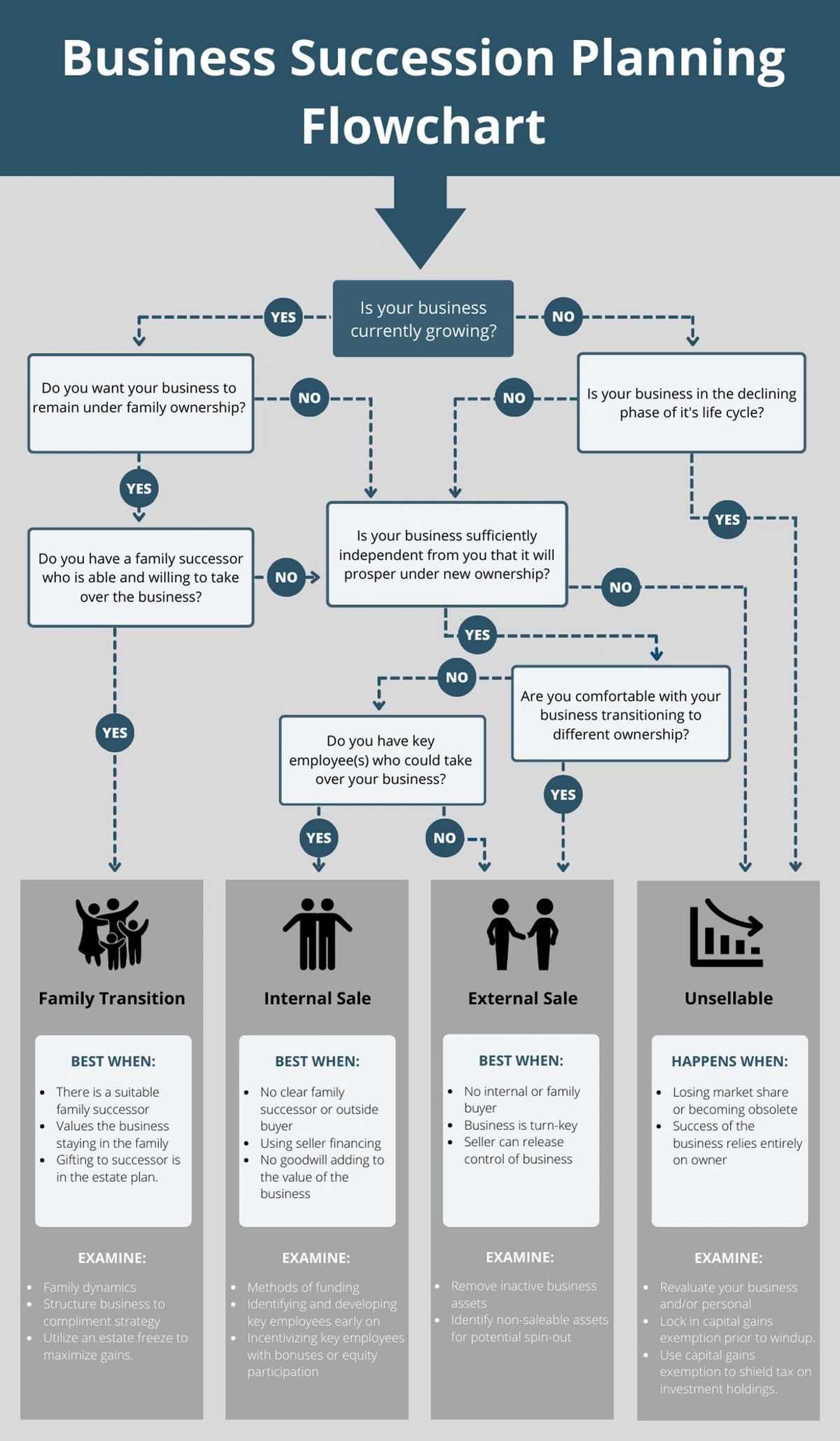
Family Transition
Primarily used when there is a clear family member who has the skills to run the business. Ideal for that owner desire to keep their business in the family. The owner's goal could be to use the business itself as a legacy to be passed down. This method can create long-lasting generational wealth, not just cash inheritance. This method is ideal for tax planning to save on taxes.
Being clear and transparent is important. Think through the financial compensation of non-active family members to avoid conflict because of the perception of special treatment. This can possibly be the most emotionally difficult method. Family issues can destroy a business. Only 30% of family businesses keep the same name and ownership following an inheritance event. If there isn’t a clear family member with the right business skills, don't force this type of transition.
Internal Sale
When there isn’t a clear family successor, a partner or employee buy-out is a great option to keep the transition in-house. This can be the smoothest transition because the buyer already has the knowledge of daily operations and its employees. This is a fantastic strategy for owners that want to ensure a smooth transition for their customers.
One of the most difficult parts is the lack of funds to purchase the business. Seller financing can be a great way to make this transition because it reduces the tax liability for the owner. Seller financing requires trust in the borrower and puts an increased risk on the owner because if something were to happen to the business, the owner could be left with a loan that couldn't be repaid.
External Sale
When there isn’t an obvious successor, owners look to another entrepreneur or competitor to purchase their business. The benefit of this method is that the seller isn't affected by how the business performs after the sale and can be less emotional. This route can be hard for owners because they typically don’t know the buyer and there is less control over what happens to the business after the sale.
The purchaser will want to see proof that this business is profitable and can transition well. Making the business stable and turnkey beforehand is essential. For a higher valuation, and buyer's confidence, sellers will typically stay after the sale to show procedures and operations
Unsellable
If your business is in decline, it shouldn’t be a surprise that you can’t sell your business. Common issues include the industry becoming obsolete, bad company culture, or failure to fund the business’s growth plan.
Even if the business is doing well, it still may be unsellable if your business can’t run independently from you. This can be surprising for owners to find out their business doesn't have value if they wanted to sell. A business is only worth what someone else is willing to pay. Typically this is found with owners that have a hard time delegating tasks. This problem can be changed. Realizing where your business is is important. Create a plan to empower your employees and make your business turnkey. Making your business self-reliant will not only increase the business value in the future but you benefit now by reducing your stress and work hours. Contact us if you want to talk to a financial advisor about how your business can plan for the future.
About the Author
Noah Schwab CFP® is a financial advisor in Spokane, Washington who specializes in helping Spokane small business owners.
- Synergizing business and personal finances
- Setting up retirement plans
- Investment management
Resources:
Statistic on business owners: Link
How we help small business owners: Link
Succession planning basic: Link
How to create a succession plan: Link