

Performance (even in an election year)
2nd quarter 2024 continued this year's growth, but only in certain areas, such as large tech and international. Overall, the market looks "okay" right now. We see cracks in the economy, but nothing significant yet to signal we are in a recession. Real estate delinquencies and credit card debts are rising. As we continue to see this overvaluation in information technology, we are conscious and cautious of this risk in our portfolios. If the S&P 500 were equally weighted instead of larger companies having a significant influence over the index, its growth would be 3% instead of 15.29% this year. This means the growth came from very few large tech companies. The good news is that non-tech companies have yet to experience a substantial overvaluation, which is one area of the market that we are excited about. These investments have opportunities, especially if interest rates linger higher for longer because they don’t have to finance operations. Also, they are relatively cheap, and inexpensive companies perform well in a recession. The following table shows domestic and global index returns for the 2nd quarter of 2024 and year-to-date 2024.
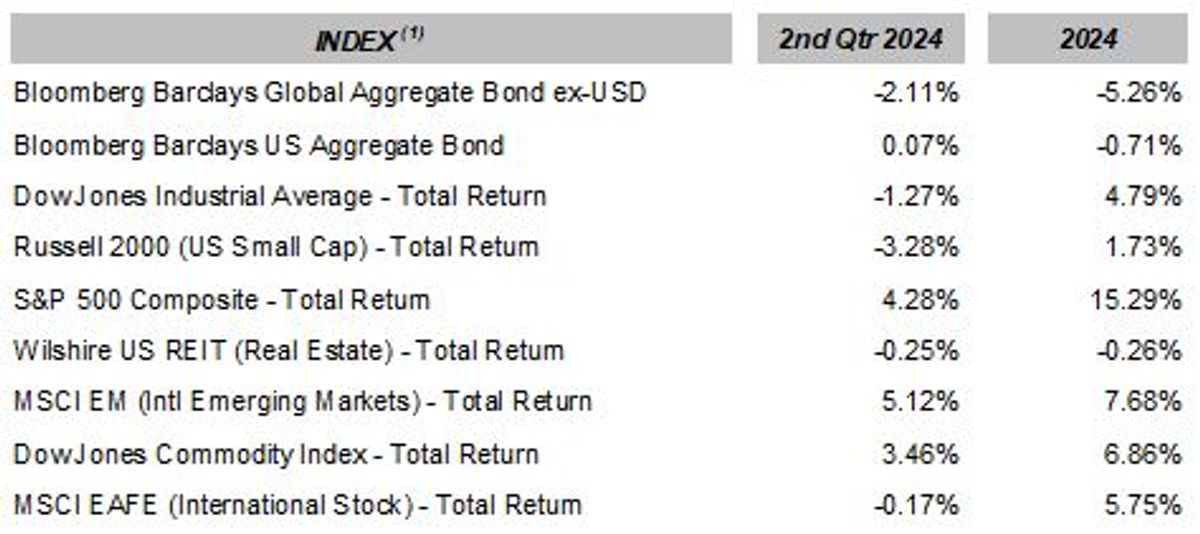
As we continue this election year, I will continue to beat the dead horse and remind everyone that staying invested in an election year still makes sense. One obvious reason is that it's been a good year so far in the market. The statistic I'll bring up again from the first quarter commentary is the historical returns during an election year. The S&P 500 has positive returns 83% of the time in an election year, regardless of which party won. It's important to stay invested. Many factors outside of politics, like the market cycle, inflation, interest rates, valuations, and earnings, affect our economy.
Nvidia & AI
Building on the AI story from Q1, Nvidia has emerged as a frontrunner, becoming the most valuable company (on certain days). It has ascended to the size of Apple and Microsoft. Renowned for its computer graphics processors used in gaming and data centers, Nvidia has experienced massive growth these past years, courtesy of its chips' advantages in AI applications. However, its future hangs on whether it can sustain its growth and market share. It will be interesting to see if it can translate expectations into reality.
New technologies can be very exciting, but it's important to recognize where and how that technology will impact company revenues. We've identified four areas and a few companies that stand to gain from AI technology. Applications: These benefits include Meta, Adobe, Microsoft, and Salesforce. Models: These benefit Alphabet and Open AI (Microsoft). Infrastructure: These benefit Microsoft, Amazon, and Arista Networks. Semiconductors: These will benefit NVIDIA, Broadcom, TSMC, and ASML.
AI companies have had an over-enthusiastic rally this past year. Critics believe this could be another dot-com bubble, but we don’t anticipate this to be the case. The dot-com bubble was a period in the early 2000s when internet companies were massively overvalued. Any company with a website skyrocketed, and actual profits didn't back up the stock price. The bubble eventually popped, and companies’ stock prices came crashing down. We don’t believe this is a repeat of the dot-com bubble because AI has significantly increased revenues for these companies, unlike in the early 2000s.
Cash
We are seeing a lot of cash on the sidelines right now. According to a study from Capital Group, total money market funds were at 3 trillion in 2018, 4.79 trillion in 2020, and 6 trillion in 2022. People are chasing higher and shorter yields right now. This may be a mistake because we see yields coming down eventually. Locking in yields for longer is what we are doing right now. Once interest rates drop, we could see this money be reinvested into the stock market.
Labor Market
Friday's job report initially appeared solid, with nonfarm payrolls rising by over 200,000 in June. However, revisions to the previous two months reduced the net gain to 95,000, with the private sector adding just 50,000 jobs. Despite nonfarm payrolls being up by 2.6 million from a year ago, civilian employment—an alternative measure that includes small business start-ups—has increased by only 195,000 over the past year. This discrepancy may be partly due to the recent surge in immigration, affecting the accuracy of household surveys.
Several anomalies raise questions about the data's reliability. Persistent negative revisions in payroll reports, lower response rates from employers, and a significant shift from full-time to part-time jobs suggest underlying economic issues. While these oddities don't imply deliberate manipulation, they highlight growing skepticism toward government reports. Overall, the job market is in a delicate balance between the robust payroll report and weaker civilian employment figures, indicating we aren't in a recession. Still, there are early signs of a slowing down economy.
Inflation & Interest Rates
Inflation and the Fed's fund rate will continue to drive the future of our economy in 2024. If inflation is stubborn for the rest of the year, we could see higher interest rates for longer and a higher employment rate. This would lead to downward pressure on stock prices. For the first quarter, we said the Fed anticipated three rate cuts at 0.25% each in 2024. We've had somewhat good inflation data since then. At its June meeting, the Fed held interest rates steady at 5.25% and 5.5%. The Federal Reserve's June meeting minutes show officials still disagree over how many months of good inflation data might be needed before the central bank is confident that low inflation is here to stay before cutting interest rates. Some leaned toward patience, while others didn't. Now, the average projection of Fed officials has lowered to only one rate cut for this year instead of three forecasted in March. The markets see a 70% chance of a rate cut in September and two over the next 12 months. Overall, we are seeing the process of the Fed move from a more restrictive stance to a more neutral one.
We'll have to see what happens with inflation for the next few months. A massive danger is if the Fed cuts interest rates too soon and quickly. This could lead to another rise in inflation. We'd almost rather have them keep them elevated for longer, even if we experience a recession because we don't want to repeat what happened in the 80s with a premature cut leading to another surge in inflation. Another huge obstacle that the Fed must navigate is the increased cost of our national debt. If rates stay higher for longer, our debt will be refinanced at a higher rate, resulting in a higher cost.
Debt Snowball
For 2023, the federal government collected $4.5 trillion in revenue and spent $6.2 trillion. This means that the federal government spent 1.7 trillion more than it collected. Our government had to borrow $1.7 trillion to maintain its current budget. It doesn't take a rocket scientist to realize this is unsustainable.
Social Security faces significant challenges. It has been borrowed from and is underfunded. A significant headwind to Social Security is our country's low birth rate. Many developed countries worldwide, including ours, are experiencing low birth rates. This puts pressure on social programs because fewer people will be working to fund programs when older generations enter retirement and draw from Social Security, Medicaid, and Medicare.
As of 2024, our national debt is $34 trillion. The estimated interest we are paying on our debt this year is $870 billion—that is correct: billion with a "B." Our debt is estimated to increase to $951 billion in 2025.
This time around, interest rates will stay higher for longer. Carrying debt didn't cost us much for the past decade. In today’s interest rate environment, it hurts more. When our government must repay the bonds to their issuers, it will have to issue a new bond at a higher interest rate, costing even more interest payments. 31% of all U.S. government debt will mature over the next year.
Looking Forward
Unlike our country, companies’ balance sheets are strong and have held a healthy amount of debt through this cycle. Internationally, we also see opportunities because these companies are trading at lower valuations than their US counterparts. More people invest in the US stock exchanges than the European stock exchanges. This might explain why we've seen another interesting trend of European companies getting listed on the US stock exchanges for better access to capital markets.
As we continue through 2025, we'll watch the market as it enters the recession of the normal market cycle. We look forward to when inflation is under control and the recession is behind us. In our client's portfolios, we continue to hedge against tech volatility in equities and lean towards large cap, quality, and dividends. We continue to rebalance portfolios into more active ETF structures this year. ETFs have lower costs and better tax advantages over mutual funds.
Please reach out if you have any questions concerning any portion of this report. If you're looking for a financial advisor near you, check out the guide to the best 5 Spokane Financial Advisors for 2024.

About the Author
Noah Schwab CFP® is a financial advisor in Spokane, Washington, specializing in helping couples with 401k five years from retirement.
- Fiduciary. No commission, no products
- Investment management and financial planning